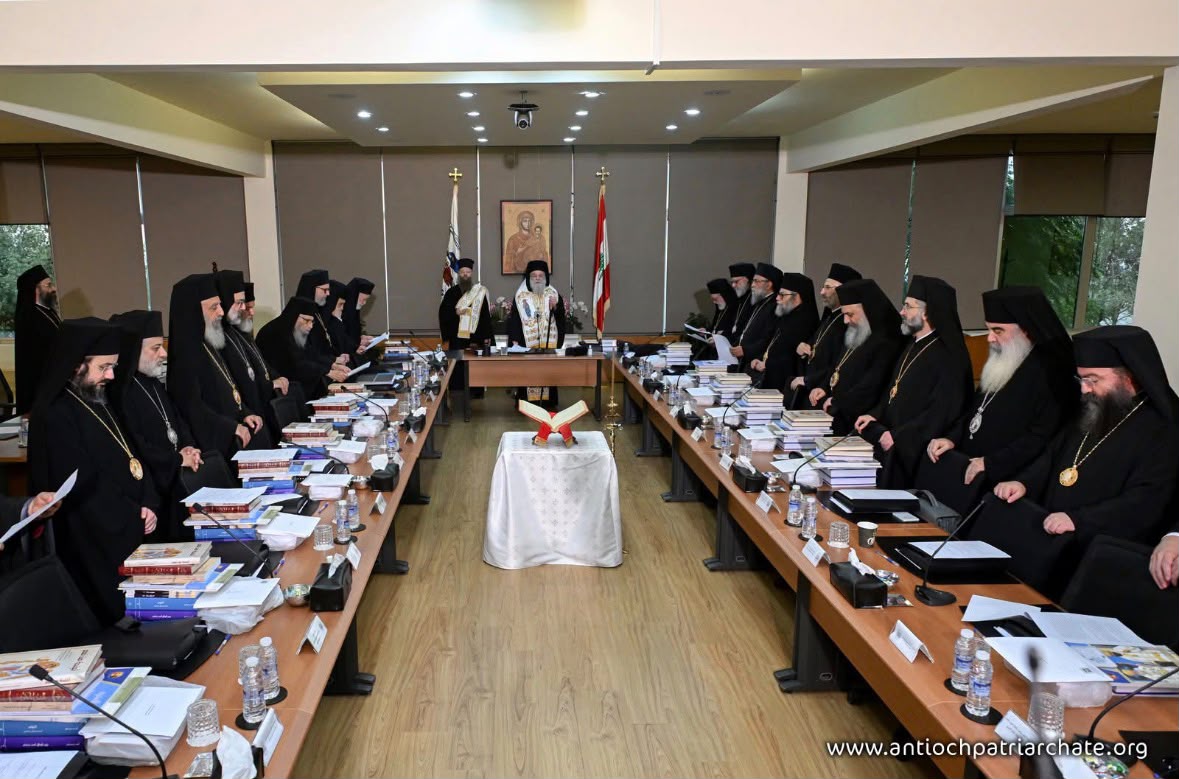
Today marked the opening of the Holy Antiochian Synod in its sixteenth synodical session, presided over by His Beatitude Patriarch John X and attended by their Eminences the Metropolitans: Elias (Beirut), Elias (Tyre and Sidon), Damaskinos (Brazil), Saba (North America), Silouan (Jbeil and Batroun), Basilios (Akkar), Ephraim (Tripoli), Ignatius (France), Isaac (Germany), Ghattas (Baghdad and Kuwait), Silouan (British Isles and Ireland), Antonios (Zahle), Nicolas (Hama), Basilios (Australia), Ignatius (Mexico), Athanasios (Latakia), Yacoub (Argentina), Ephraim (Aleppo), Niphon (Shahba), Gregory (Homs), and Antonios (Bosra, Hauran, and Jabal al-Arab). Metropolitan Sergios Abad (Chile) was the sole absentee. Metropolitan Paul Yazigi was present through the prayers of the Holy Synod’s Fathers.
Following the opening prayer, the synodical proceedings commenced with an opening speech by His Beatitude, touching upon several vital points concerning the mission of the Church, its role, and its presence in the Levant, and culminating in the importance of Antiochian unity and synodality in facing current challenges. His Beatitude began by declaring: “As we gather today, we are burdened by the cross of historical responsibility.”
In addressing the mission and responsibilities of the Church, His Beatitude emphasized the Church’s calling to continue its mission without surrender, stating: “Everyone asks the Church for everything when governments fail in so many things, and numerous indeed are those failures. We are neither wonderworkers nor do we surrender. Rather, we labor with all our strength to bear witness to the love of Christ, who first loved us.”
From this mission based on witnessing for Christ, His Beatitude proceeded to the idea that: “In Christ there is a beauty and goodness that neither human folly nor petty disputes can tarnish through either unjust or justified criticism of a Church that neither claims nor has ever claimed for herself utopian perfection or infallibility. Indeed, infallibility belongs to the Lord alone.”
On the national level, His Beatitude affirmed that our presence in this East is not a transient matter, and that in following up on conditions, we strive to speak the word of truth—that which unites and serves all citizens without discrimination—while seeking to stay as far away as possible from the corridors of politics that divide.
His Beatitude then moved on to emphasize the importance of solidarity within the Antiochian family, saying: “As Antiochians of the Levant, present circumstances require us to join hands through the solidarity of all our archdioceses, embodying that solidarity in deeds and not merely in words.” He added: “The Church of Antioch is one and united, both in the homeland and abroad, despite all the challenges that arise from her dispersion across many nations and among diverse cultures and civilizations.
Hence the importance of fostering Antiochian thought and Antiochian identity through language, theological reflection, and authentic tradition, recognizing Balamand as one of its principal pillars. The Church of Antioch remains one and united through the complete sense of belonging of her diaspora archdioceses to the Mother See, and through the recognition by the Mother See that her archdioceses abroad are an extension of herself.” He continued: “The Church of Christ is one communion, wherein conciliarity is not a rigid ritual but a lived reality and a shared journey expressed on many levels. Therefore, the Holy Synod is the culmination of this journey.”
These words marked the opening session and imprinted it with pivotal matters concerning the very foundation of the Church, its existence, and its internal and external relations.
Following this, many Metropolitans presented reports on their archdioceses, detailing their conditions, the difficulties they face, their achievements, and the visions that our Fathers the Pastors aspire to.
With the title “Anxieties of Service and Pastoral Care”, with such a pater