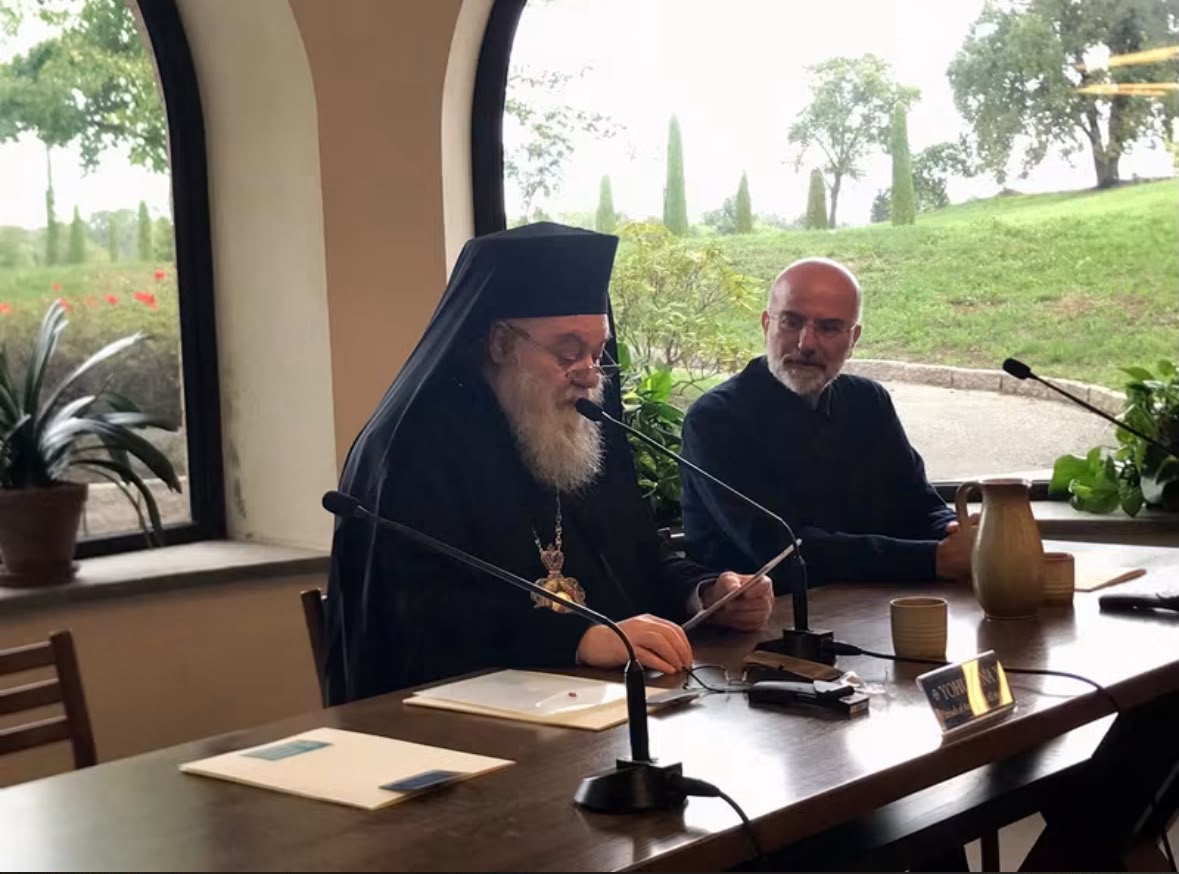
Christians of the Middle East. From Survivors to Peace makers.
Distinguished guests, Excellencies, ladies and gentlemen,
When we speak about Christians in the Middle East, we should not begin with their disappearance. We should begin with their presence. Christianity is not a foreign presence in the Middle East. It was born there. Its earliest communities were established there, and desciples were called Christians for the first time in Antioch as it is mentioned in the Acts of the Apostles. For centuries Christians have shared in the history, culture, intellectual life and development of that region. Their churches, monasteries, schools, universities and hospitals are part of the living heritage of the Middle East. And therefore, when we speak about the future of Christians in the Middle East, we are not speaking simply about preserving a chapter of history. We are speaking about the future of the Middle East itself. The Christian presence is a living presence, and it should remain part of our shared future.
These contributions remind us of something important: The Christian presence is not only about what Christians need from society. It is also about what Christians contribute to society.
That is why the question of Christian presence should not be reduced to the question of minority protection. Of course, protection matters. Security matters. Freedom of religion matters. But we should aspire to something greater than protection alone. We should aspire to equal citizenship. A society in which Christians do not merely survive, but participate fully. A society in which Muslims, Christians and people of every faith or conviction stand equal before the law. A society in which identity is not a reason for exclusion, but diversity is recognized as part of the richness of the nation. This is not only a Christian aspiration. It is a principle of good governance. It is a principle of human dignity. And ultimately, it is a principle of stability. Because a society that protects the rights of its minorities is strengthening the rights of all its citizens.
We must also be honest about the challenges. Across parts of the Middle East, Christian communities have experienced conflict, insecurity, economic hardship, discrimination, displacement and emigration. In some places, the numbers have declined dramatically. And perhaps the most painful dimension of this decline is the departure of young people. Young men and women leave because they are looking for security, opportunity, education, employment and a future for their families. And this raises a question that I believe should concern all of us:
What kind of Middle East will we build if its young people no longer believe that they can build their future there?
This is not only a question for Christians. It is a question for the entire region. A young Christian should not have to choose between his or her faith and a secure future. A young Muslim should not have to choose between remaining in his or her country and having an opportunity to prosper.
The answer, therefore, cannot simply be to ask Christians to stay. We must help create the conditions that make staying a meaningful choice. This requires to give them, above all, hope. Hope that one’s children can grow up safely, that one’s work can have a future, that one’s faith can be practiced freely. Hope that one’s community has a place in the country it calls home.
Ladies and gentlemen,
This is where political leadership becomes essential. The future of Christian communities cannot depend indefinitely on exceptional protection, political patronage or international attention after every crisis. What is needed is stronger institutions and a culture of citizenship. Institutions that protect every citizen. Laws that apply equally to everyone. Education that teaches respect rather than division. Political systems that allow citizens to participate regardless of their religious identity. And societies in which religious and cultural diversity is not regarded as a threat, but as a source of strength.
This is not an unrealistic ideal. It is a practical foundation for peaceful societies. And here, I believe, Christians have an important role to play. Christians should not be seen merely as a community that needs to be protected. They should be seen as partners. Partners in everything, especially in the difficult work of rebuilding trust and peace between communities.
The Christian presence can therefore be part of the solution—not simply a subject of concern.
And this brings us to the central message we would like to leave with you today.
The question before us is not simply: “How do we preserve Christians in the Middle East?”
The deeper question is: “How do we build a Middle East in which Christians, Muslims and all citizens can flourish together?”
That is a much larger—and, I believe, much more hopeful—question. Because the future of Christians cannot be separated from the future of their societies.
If there is security, Christians benefit. If there is justice, Christians benefit. If there is freedom, Christians benefit. If there is economic opportunity, Christians benefit. But so does every citizen.
Therefore, defending the Christian presence is not about creating separation. It is about defending the principle that every human being has the right to belong, to participate and to hope.
Excellencies, ladies and gentlemen,
That, ultimately, is the vision we should pursue. Not a Middle East where one community survives at the expense of another. But a Middle East where diversity is protected, citizenship is equal, faith is respected, and every community can contribute to the common good. The Christian presence in the Middle East is not merely a memory of the past. It is a living presence. And with wisdom, courage and political leadership, it can— and should— be part of our shared future.
The Middle East has known conflict, division and suffering. But it has also given the world extraordinary examples of civilization, faith, coexistence, learning and human resilience. We should not allow the story of Christianity in the Middle East to become only a story of what once was. Let it remain a story of what can still be. Let churches and monasteries continue to be places of worship, but also the Christian social service centers to support the poor and the displaced. Let us support the Christian organizations to keep working as spaces for dialogue, reconciliation and collaboration between people of different faiths. Let Christian schools continue to educate generations. Let Christian hospitals continue to serve every person who needs them. Let Christian communities continue to contribute to the cultural and social life of their countries. And, most importantly, let young Christians be able to say: “This is my home. I have a future here. And I want to build that future with my neighbors.”
Allow me to recount a story from the monastic literature of our Church concerning a saint named Macarius, who was wandering the desert carrying his staff. He came across a skull lying in the sand; touching it with his staff, he asked, “Whose skull are you?” The skull replied, “I am the skull of a thief and a bandit.” The saint asked, “And where are you now?” It answered, “In Hell.” He asked again, “And what is your state in Hell?” It replied, “I am in unending pain and torment. In Hell, we are bound together, back-to-back; we cannot see one another’s faces nor speak, and this is what torments us most.” For true Hell is the failure to encounter the other, the inability to communicate with them, and the absence of dialogue.
Thank you.