
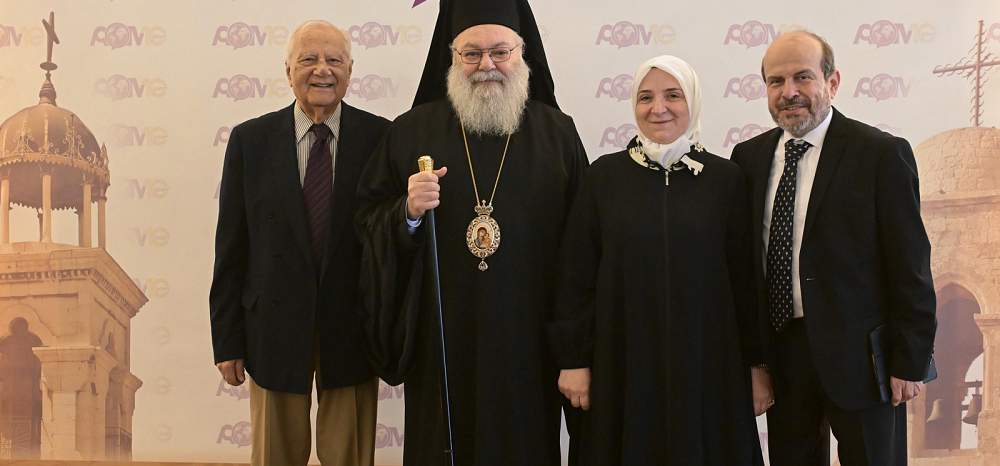
Dialogue sessions on Islamic-Christian relations, social welfare, and the statement of the present and the awaited hope… as part of the sessions of the Holy Antiochian Synod
The fourth day began with a continuation of the dialogue sessions moderated by journalist Zeina Yazigi. The first theme of these sessions, titled “Islamic-Christian Relations,” featured speakers: Dr. Mohammad Al-Sammak, Secretary-General of the National Islamic-Christian Committee for Dialogue in Lebanon; Asma Kaftaro, member of the Syrian Women’s Advisory Council; and Professor George Tamer, an academic specializing in philosophy and Islamic studies.
The speakers emphasized that we in the East live as a single nation with multiple religions, ethnicities, and sects. They called for coexistence, or civil peace as it is also called, not to be understood as a theoretical term used in some discussions, but rather as a living value that allows us to express the unity of our will and the diversity of our identities. The speakers also emphasized that Christians are an integral part of the national fabric. Therefore, exclusionary discourse must be countered with an open and constructive ecclesiastical discourse that launches practical initiatives through joint meetings and dialogues on issues of public concern. This is to highlight the historical dimension of coexistence as a guarantee of social and national stability, on the one hand, and the great importance of the Orthodox Christian role in building bridges of trust and understanding in religiously and ethnically diverse societies, on the other.
The second panel, titled “Social Care in Times of Crisis,” featured the Director of the Patriarchate’s Department of Ecumenical Relations and Development (GOPA-DERD), Archimandrite Meletios Shatahi; social worker Doris Bandali Anton; and head of the Norwegian Church Aid mission in Syria and Lebanon, Mrs. Ruba Khoury.
The interventions indicated that in times of crisis, the Church remains closest to the people because it attends to all their psychological and material needs, supporting all possible efforts at home and abroad. This relief role undertaken by the Church is not merely a task to which it was called upon to respond to urgent needs, but rather a practical application of its vision for others, regardless of who that other may be. Consequently, it is a realization of its neutral identity, which does not discriminate based on color or lineage. The history of the Church of Antioch has a long history of achieving civil peace through the social care it provides to all people, in addition to preaching and speech. While it is possible for a word to err, an act of love can never err, for it is based on the ethics of the Gospel.
The discussions and debates also addressed the multitude of social needs, from health and education to combating unemployment and preserving family cohesion. She also presented existing experiences, such as social health centers, charity kitchens, support funds, and school grants, which serve families within the country, in addition to connecting displaced families with our parishioners abroad for pastoral care.
The third and final panel, titled “In the Statement of the Present and the Expected Hope: The Church in Times of Tribulation: Dangers, Challenges, and Approaches to Confrontation and Motivation,” featured lawyer Carol Saba. He explained that today’s world, in both East and West, is afflicted with political, social, economic, and even spiritual exhaustion. This exhaustion creates complex dangers and challenges that the Church must be prepared to confront with an executive vision and practical proposals that move it from the equation of reception and withdrawal to one of directness and initiative. These synodal sessions, the invitation of some specialists to speak, and the reception of some participating guests, are a wise initiative by His Beatitude Patriarch John X to realize this vision and weave the first thread of an ecclesiastical safety net that unites the church, its pastors, and its parishioners for consultation and exchange of experiences.
The Antiochian Orthodox Church is the prime candidate to fulfill this unifying role because it is the oldest church built on the foundation of pluralism, bringing everyone together under its wings, regardless of their ethnicity or race. This unifying role is summarized in spreading a social awareness open to others, like the Good Samaritan, and building a human being who respects the values and morals taught by religions. Everyone must be on the same page so that they can build a democratic homeland where everyone lives in peace and prosperity.