
His Excellency Prime Minister Judge Nawaf Salam, representing His Excellency the President of the Republic, General Joseph Aoun, and His Excellency the Head of the Lebanese Parliament, Mr. Nabih Berri,
Your Eminences, members of the Holy Synod of Antioch,
Your Eminences, Metropolitans and Bishops,
Your Excellencies,
Your Beatitudes, Your Eminences, and Your Excellencies, heads of the religious communities and their representatives,
Fathers, priests, monks, and nuns,
Members of Metropolitan George’s family,
Faithful of this holy archdiocese,
Christ is risen!
O great departed one,
Like the righteous palm, you flourished in grace;
Like the cedar of Lebanon, you stood firm.
In the Lord you found your joy and light;
In His righteousness you took delight.
Upon the Lord you cast your care,
And found unfailing mercy there.
Your hope in God was never vain,
Nor did your trust return in vain.
Your heart was crowned with righteousness,
Adorned with faith and steadfast love.
Therefore your branches spread afar,
Bearing witness to the living God.
With words from the Book of Psalms, which you loved so dearly, I address you today. Forgive me, O master of the word and servant of the Letter, that these days have placed me before you, seeking guidance and drawing inspiration from the clarity of your eloquence.
Now set forth on your journey to the Beloved, whom you have loved since your earliest years. Go forth to the One who bestowed upon you light, eloquence, humility, and the wisdom of the fishers of Galilee. Meet the One who dwelt within you, or, as you preferred to say, the One who “pitched His tent among us,” planting His love deep within your heart, illuminating you and making you a light to others.
My beloved ones,
When Jesus came to the tomb of Lazarus, He wept. Though He knew that within moments He would call him forth from the grave, He still wept, until those standing nearby said, “See how He loved him.”
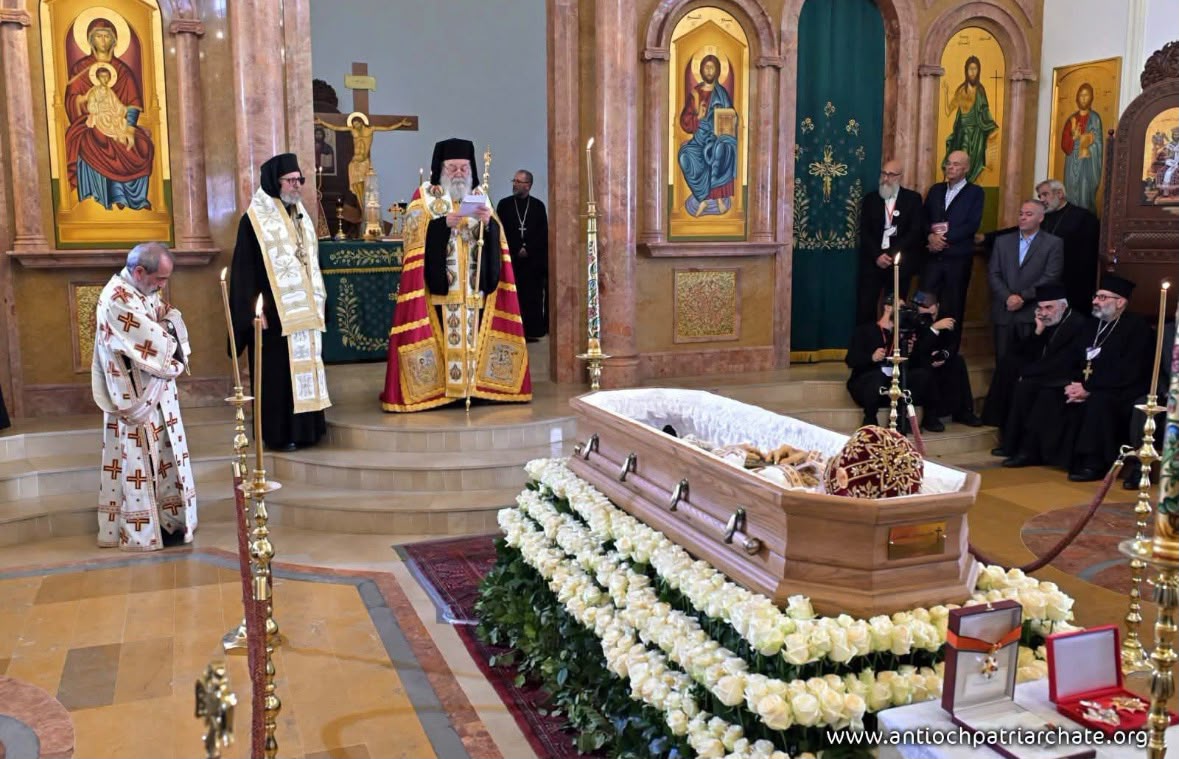
As we stand today before the body of our brother, Metropolitan George, we find ourselves in something of that same moment. We proclaim, “Christ is risen!” yet tears overcome us. Perhaps whoever enters this church today and beholds your faces will likewise say, “See how much they loved him.”
Metropolitan George once wrote that death is “a parting of the eyes.” Today we know deeply how painful that parting can be. We miss a face that had become familiar to us and a voice from which, over the years, we awaited a word whenever we were troubled or perplexed.
During his final days he often remained silent for long stretches. If someone asked what occupied his thoughts, he would simply reply: “I am contemplating Jesus.”
How abundantly Metropolitan George wrote for us, and how rich he was in both word and deed. Yet when his words became few, he revealed in a few simple words where his heart had dwelt all these years. He was contemplating Jesus. It was from Jesus that he came to us, and it is to Jesus that he now returns. Though we miss his voice, I can still hear those words.
Perhaps among us today are those who remember how attentively Metropolitan George listened, whether to the young or to the old, giving each person ample room to speak and express what was in their heart.
I remember how much he loved to chant to the Virgin Mary:
“All creation rejoices in you, O Full of Grace.”
He reflected often upon the mystery that she who was called “full of grace” was also the one to whom it was said that a sword would pierce her soul. She answered the angel, “Let it be unto me according to your word,” and years later she stood at the foot of her Son’s Cross. There, her first words attained their deepest meaning.
There was something of that same fidelity in the life of Metropolitan George. From the moment the people cried out, “Axios! He is worthy!” at his consecration, he carried in his heart the Lord’s words:”For their sake I sanctify Myself.”
Day after day, he learned what it meant to remain close to those whom the Lord had entrusted to his care. There are times when a shepherd sees those whom he loves in suffering and yet cannot take their pain away. All he can do is remain beside them.
Metropolitan George understood the value of such presence. He knew how much of Christ’s tenderness reaches the human heart when someone sits beside another and endures with them. The Lord asked Peter, “Do you love Me?” and then commanded him, “Feed My sheep.” Between that question and that command, Metropolitan George lived out his priesthood and episcopal ministry, first as a priest in Tripoli and then as Metropolitan of Mount Lebanon. He loved his people and his clergy. He desired that each person discover the gift God had placed within him or her and minister accordingly.
He cherished monastic life and sought to see it flourish in the monasteries entrusted to his fatherly care. He had the rare gift of entrusting someone with a task dear to his own heart and then rejoicing as that person fulfilled it in his or her own way. Many among us discovered our talents because Metropolitan George saw them before we ourselves did and entrusted us with responsibilities through which those gifts could blossom.
When displaced families sought refuge within this archdiocese, he heard anew the Lord’s words:”I was a stranger and you welcomed Me.”
He sought to understand how those who had lost their homes were living, what they feared, and what they hoped for their children. He organized relief efforts, opened medical clinics, accompanied families through their hardship, and later worked to facilitate their return to their villages and the rebuilding of their homes and churches.
He, who taught that the whole world is a place of worship, understood where prayer leads us when we rise from it. It leads us to our neighbor’s doorstep, especially when that neighbor is suffering, poor, displaced, or alone. For there too we encounter Christ, who identified Himself with the least of His brethren.
This is why we understand his steadfast defense of the rights of the Palestinian people. In the cry of a people deprived of justice, he heard the voice of the human person in whom Christ Himself was present. He could speak about peace while simultaneously naming injustice and calling for what must be restored. He hoped that, whenever Lebanon emerged from a trial, the solidarity of its people would endure, and that forgiveness and creative coexistence would open the way toward a life in which all could find a place.
My beloved ones,
Metropolitan George was truly a son of Antioch. He loved its remarkable ability to bring people together. He carried this spirit into university lecture halls and ecumenical assemblies, bearing witness to Antioch’s faith together with his companion on the journey, Patriarch Ignatius IV of thrice-blessed memory.
In dialogue, he prized clarity and understanding. He stated what he believed plainly and listened carefully until he understood what the other believed. Whether teaching Islamic civilization at the Lebanese University, reading the Holy Qur’an with attentiveness, or listening to the wisdom of the Sufi tradition, he was doing something our country needs every day: listening carefully to one’s neighbor speak about what is most precious to them and receiving those words with respect and seriousness.
Those who awaited his weekly column knew that he wrote for all Lebanese. He was concerned with how each citizen might become responsible for the dignity and well-being of the other. In his essay To the Christians of My Country, he called us to love this world through excellence in work, through knowledge and creativity, and through everything we create together for the benefit of humanity. He considered creativity to be “a hidden presence of Christ in the world.”
Just as he hoped that the people of this country would come to know one another more deeply, he desired that the members of the Church advance even further in fellowship, prayer, and service.
For this reason, together with his companions, he helped found the Orthodox Youth Movement and later carried the same concern to Orthodox youth throughout the world through Syndesmos, the World Fellowship of Orthodox Youth.
He rejoiced whenever a young person discovered that, from the moment of baptism, they had a place in the Church and a share in its ministry.
His fatherhood was illuminated by the words of John the Baptist:
“He must increase, but I must decrease.”
It brought him joy to see his spiritual children mature in freedom and stand before Christ with conscience and integrity. This is among the highest expressions of authentic love in one who has received the gift of fatherhood.
In his final days, as he continued to whisper the Psalms, we recognized once more the man we had known for so many years. He became a metropolitan, yet in his heart he remained a servant and a monk.
Then came the days when the shepherd himself needed someone to care for him.
We witnessed our brother, Bishop Silouan, care for him as a son cares for his father. We saw Deacon George attend to him day and night. To both of them we offer our heartfelt gratitude for the devotion they showed and for the tenderness Metropolitan George experienced in his weakness.
During those days, the Lord’s command, “Feed My sheep,” took on a special meaning in the Diocese of Mount Lebanon. The one who had long shepherded the flock had himself become a sacred trust in the hands of his bishop and his deacon. In that loving care we find consolation today.
Metropolitan George loved the holy icon. How deeply he reflected on its relationship to the human face. When we stand before an icon, our gaze rests upon a face, and through that face our hearts are lifted to God.
Today we look upon a face we loved, and through it we lift our hearts to the Lord who loved him first.
Tomorrow, when we long for Metropolitan George, we may open one of his books or tell our children stories about the man he was among us.
Perhaps a passage we read will remind us of someone he used to remember in prayer: a sick person from whom we have become estranged; a newcomer to our country whose family we have never asked about; a person against whom we still harbor resentment and to whom it is time to offer peace; or a young man or woman waiting in the Church for someone to listen and entrust them with a responsibility.
Let us go to the places of worship where Metropolitan George taught us to encounter Christ. And when our children ask why we loved him, may we be able to offer them not only stories about him but also a portion of the love that animated his life.
On my own behalf, on behalf of my brothers in the Holy Synod of Antioch, on behalf of Bishop Silouan, and on behalf of the priests, monks, nuns, sons, and daughters of the Diocese of Mount Lebanon, I thank you for praying with us today and for joining us in bidding farewell to the one who shepherded and loved us so faithfully.
And to the family of Metropolitan George, we say that we share in the sorrow of your parting. Together with you, we thank God for His love and faithfulness, just as we thank Him for the fatherly guidance and care He bestowed upon us through His servant.
Lord Jesus Christ, most sweet Jesus, remember Your servant Metropolitan George in Your Kingdom. Remember him for his prayers, his labors, and his love for You and for those whom You entrusted to his care. Remember him in his strength and in his weakness, as You alone know him. Receive his years of service to You and to Your people. Forgive him every failing committed in human weakness. Grant him rest among Your saints, and comfort the hearts of us all.
And when we long for his voice, bring us back to the words of life that he shared with us and through which he enriched the Arabic-speaking Church. Bring us back to those final words he spoke, and grant us the grace to contemplate You, O Lord, who alone were his hope and his love.
Once again, I address you from the Psalms:
Blessed is the one who fears the Lord,
Who delights greatly in His commandments.
Honor and abundance dwell within his house,
And his righteousness endures forever.
Light dawns in the darkness for the upright,
For the compassionate, the merciful, and the just.
The righteous are generous and kind.
They distribute freely and give to the poor.
Their righteousness endures forever.
Eternal is the remembrance of the righteous.
In righteousness they blossom and spread their branches wide.
And I would add:
Hail to you, O man whose prayers
Captivated minds and stirred hearts.
Hail to you, O man overflowing with wisdom
And with words of rare beauty.
Hail to you, O shepherd who revealed consolation
To the flock entrusted to your care.
Hail to you, O mighty cedar of Lebanon,
Firmly rooted in the soil of our beloved land.
May his memory be eternal.
Christ is risen!