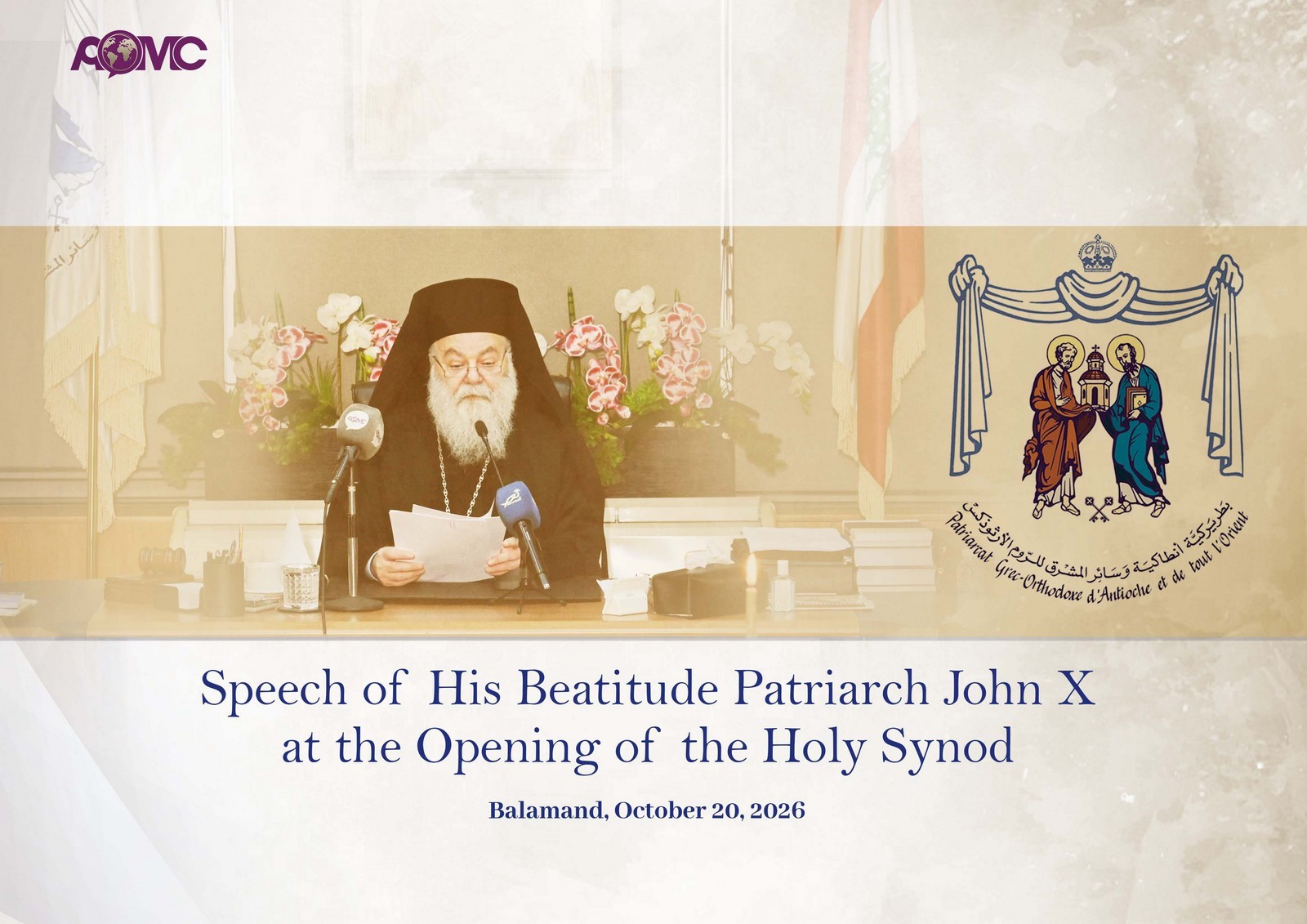
Reverend Hierarchs,
It pleases me to address you at the opening of this Synod, which is the gathering of all into one. Today, we are in the presence of the Holy One, whom we ask to bless our Church, a Church that has borne witness and suffered martyrdom throughout history, especially at this time as it bleeds alongside this Levant.
As we gather today, we are burdened by the cross of historical responsibility. Everyone asks the Church for everything when governments fail in so many things, and numerous indeed are those failures. We are neither wonderworkers nor do we surrender. Rather, we labor with all our strength to bear witness to the love of Christ, who first loved us. We seek no judgment from anyone save from the right hand of God, who planted us here. We do not claim perfection, nor do we pursue utopian ideals, either for ourselves or for others. We are here to place the reality of our Church before us and to deliberate upon it in a spirit of meekness and Gospel-inspired grace.
In Christ there is a beauty and goodness that neither human folly nor petty disputes can tarnish through either unjust or justified criticism of a Church that neither claims nor has ever claimed for herself utopian perfection or infallibility. Indeed, infallibility belongs to the Lord alone.
Our presence in this East is not transient. Our presence here is intrinsic to our very Christianity. The late Patriarch Ignatius said: “Christ is Middle Eastern. He lived here and walked here. Jerusalem, Damascus, Beirut, and other places are not merely a handful of soil. This land is where Christ became incarnate.” Patriarch Elias IV likewise said: “Antioch is she who embraced the world and girded it with the truth of the Incarnation; she who bestowed upon the world the name ‘Christians’ and made it resound as a melody on the lips of succeeding generations.”
I say this as I turn to our social and national reality, both in the homeland and throughout the diaspora. Files accumulate upon the synodal table, which seeks inspiration from the open Gospel set before us, the Gospel that was opened above the head of each of us on the day we were entrusted with shepherding the flock of Christ.
As a Church, we strive to speak the word of truth in matters that unite the nation, while seeking, as far as possible, to avoid the political corridors that divide it. While respecting the political affiliations of our faithful, we likewise respect the particular circumstances of the Levant, especially those of Lebanon and Syria. We also recognize our responsibility in the diaspora.
We are neither prisoners of our history nor oblivious to the pioneering role that history has bestowed upon us. We have always stood, and will continue to stand, beside our brothers and sisters of all religious communities. We served as a bridge of communication when the language of barricades prevailed, and we shall continue in this role because we cherish this homeland and are entrusted within it with the message of coexistence.
As Antiochians of the Levant, present circumstances require us to join hands through the solidarity of all our archdioceses, embodying that solidarity in deeds and not merely in words. As Christians of this Levant, these circumstances call us to join hands and to reject proselytism practiced here and there under the pretexts of evangelization or humanitarian aid. They call us to strengthen our sense of belonging to Christ and to reject the overemphasis on ethnic identities that can confine individuals within narrow national or racial boundaries.
We are here to address our children in the homeland and throughout the diaspora. We grow stronger through you, and you grow stronger through us. The Church of Antioch is one and united, both in the homeland and abroad, despite all the challenges that arise from her dispersion across many nations and among diverse cultures and civilizations.
Hence the importance of fostering Antiochian thought and Antiochian identity through language, theological reflection, and authentic tradition, recognizing Balamand as one of its principal pillars. The Church of Antioch remains one and united through the complete sense of belonging of her diaspora archdioceses to the Mother See, and through the recognition by the Mother See that her archdioceses abroad are an extension of herself.
It is the Church of Antioch that never forgets her historic heart or her original presence in Antioch and its surrounding regions, in Tarsus, Adana, Mersin, Cilicia, and elsewhere in southern Turkey.
The Church of Christ is one communion, wherein conciliarity is not a rigid ritual but a lived reality and a shared journey expressed on many levels. Therefore, the Holy Synod is the culmination of this journey.
With this hope, we ask the God of mercies and Father of lights to bless us all and to illumine our hearts with the radiance of His light, so that the works of this Synod may bear abundant fruit through His grace, He who is blessed forever.
Amen.